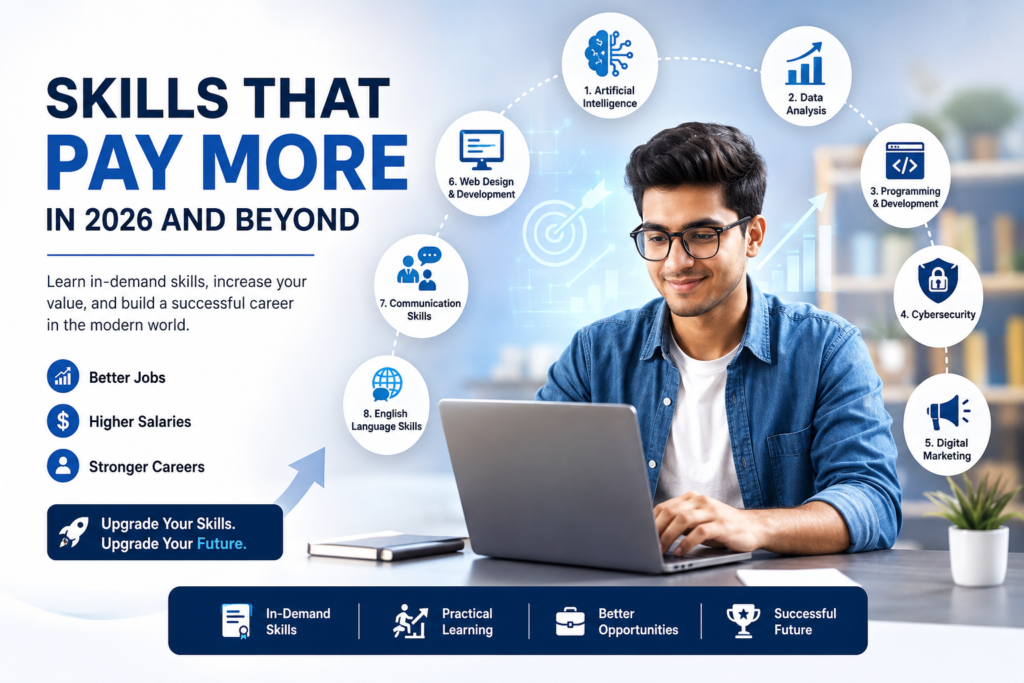
Which Skills Can Help Students and Job Seekers Earn More in 2026?
August 31, 2026
The job market is changing quickly, and having a degree alone is no longer enough to guarantee a well-paying career. Employers increasingly look for candidates who have practical, job-ready skills that can help businesses save time, increase revenue, solve problems, or use new technologies.
For students and job seekers, this creates an important opportunity: learning the right skills can significantly improve your chances of getting a better job, earning a higher salary, or starting a freelance career.
In 2026, some of the most valuable skills are connected to artificial intelligence, technology, data, digital marketing, cybersecurity, communication, and business.
This guide explores the skills that can help students and job seekers increase their earning potential and build stronger careers.
- Artificial Intelligence and AI Tools
Artificial intelligence is one of the biggest changes affecting the modern workplace.
Students and professionals who know how to use AI tools effectively can often complete tasks faster and work more efficiently. Businesses are also looking for people who understand how AI can be applied to everyday work.
Useful AI-related skills include:
Using AI assistants for research and productivity
AI-assisted content creation
Prompt writing and optimization
AI automation
AI-powered data analysis
Understanding AI concepts and limitations
Integrating AI tools into business workflows
You do not necessarily need to become an AI engineer to benefit from this trend. Learning how to use AI effectively in your existing profession can also make you more valuable to employers.
Career opportunities: AI assistant, AI content specialist, automation specialist, AI consultant, AI-supported marketing specialist and other technology-related roles.
- Data Analysis
Businesses generate enormous amounts of data every day, but data is only useful when someone can understand it and turn it into meaningful information.
Data analysis is therefore an increasingly valuable skill.
Students can begin with tools such as:
Microsoft Excel
Google Sheets
SQL
Power BI
Tableau
Python
Learning how to clean data, create reports, identify trends and explain findings can help you qualify for many business and technology positions.
Career opportunities: Data analyst, business analyst, reporting analyst, financial analyst and data-related positions.
- Programming and Software Development
Programming remains one of the strongest technical skills for people interested in technology careers.
You do not need to learn every programming language. Instead, choose a language based on your career goal.
Popular areas include:
Web development
Mobile app development
Python programming
JavaScript
Software engineering
Backend development
Automation
Programming can also create opportunities outside traditional employment because developers can work remotely, freelance, build their own products, or provide services to businesses.
Career opportunities: Software developer, web developer, mobile developer, backend developer and automation developer.
- Cybersecurity
As companies move more of their operations online, protecting information and digital systems becomes increasingly important.
Cybersecurity professionals help organizations protect networks, applications, accounts and sensitive information.
People interested in this field can start by learning:
Networking fundamentals
Linux
Cybersecurity fundamentals
Security monitoring
Cloud security
Ethical security concepts
Risk management
Cybersecurity can be a strong career choice for people who enjoy technology, problem-solving and continuous learning.
Career opportunities: Security analyst, cybersecurity specialist, SOC analyst, security engineer and related roles.
- Digital Marketing
Businesses need customers, and digital marketing helps them reach those customers online.
This makes digital marketing a useful skill for both employees and freelancers.
Important areas include:
Search engine optimization (SEO)
Social media marketing
Content marketing
Email marketing
Paid advertising
Analytics
Conversion optimization
One advantage of digital marketing is that you can demonstrate your skills through practical projects. For example, you can create a website, manage a social media page, or develop an SEO project and use the results as part of your portfolio.
Career opportunities: SEO specialist, digital marketer, social media manager, content marketer, email marketer and marketing analyst.
- Web Design and Development
Almost every modern business needs an online presence.
Learning web design or development can therefore provide opportunities in employment, freelancing and entrepreneurship.
Beginners can start with:
HTML
CSS
JavaScript
WordPress
Responsive web design
User experience (UX)
Basic SEO
As your skills improve, you can move into more advanced development technologies.
A strong portfolio can be particularly important in this field because employers and clients often want to see what you can actually build.
- Communication Skills
Technical skills are important, but communication can be just as valuable.
A highly skilled employee who cannot communicate clearly may struggle to work effectively with customers, managers and colleagues.
Students should develop:
Written communication
Business communication
Presentation skills
Public speaking
Active listening
Negotiation
Professional email writing
Strong communication skills can help you perform better in interviews, workplace meetings, sales, management and client relationships.
- English Language Skills
For people looking for international jobs, remote work or freelancing opportunities, English can be an especially valuable skill.
Good English can help you:
Communicate with international clients
Write professional emails
Attend online meetings
Create better CVs and applications
Understand international learning resources
Perform